From the Practice Room to the Stage: Getting Songs Gig-Ready
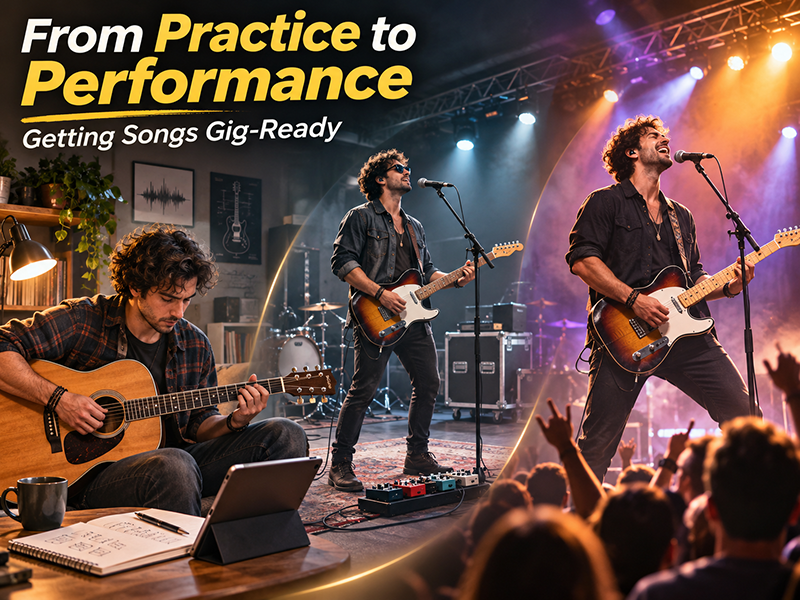
Just because you can play a song perfectly at home doesn't mean you're ready to play it on stage.
That's something I've learned over many years of performing live.
There's a big difference between sitting comfortably in your music room, concentrating on every note, and standing on a stage in front of an audience with bright lights in your face, trying to remember everything you've practised.
I recently came across guitarist Andy Wood discussing an approach to learning and performing music that really resonated with me. It's something I've been doing for years, although perhaps without giving the individual stages much thought.
The idea is simple.
There are three distinct stages to getting a song performance-ready:
Learn and practise the song.
Rehearse the song.
Perform the song.
They might sound like the same thing, but they're not. Each stage serves a different purpose, and understanding those differences can make a huge improvement to your live performances.
Stage 1: Learn and Practise the Song
This is where the real groundwork happens. Before you can perform a song confidently, you need to know what you're supposed to be playing!
For a guitarist, that means learning the chords, riffs, solos, rhythms, transitions and any other parts you're responsible for.
For a singer, it means knowing the melody, lyrics, phrasing and where to breathe.
And if you're singing and playing guitar at the same time, you have the added challenge of bringing both parts together.
This stage is all about concentration, repetition and improvement.
Practising is where you're allowed to make mistakes.
In fact, that's part of the point.
If there's a difficult guitar passage, slow it down. Break it into smaller sections. Work out exactly where you're going wrong and repeat it until you can play it correctly. Then gradually bring it up to speed.
The goal is to get those parts so familiar that they become embedded in your muscle memory. You shouldn't have to consciously think about every single finger movement when you're performing.
Think about how you learned to drive a car. In the beginning, changing gears, using the clutch, checking mirrors and watching the road required enormous concentration. Eventually, most of those actions became automatic.
Playing music is much the same.
The more familiar you become with a song, the less mental energy you need to spend simply remembering what comes next. And that frees you up to concentrate on the actual performance.
But there's a catch.
Being able to play a song perfectly while sitting in your favourite chair doesn't necessarily mean you're ready to perform it live.
That's where the next stage comes in.
Stage 2: Rehearse the Song
This is the stage I think a lot of musicians overlook.
Once you've learned the song and can confidently play it from beginning to end, it's time to stop treating it like a practice exercise. Now you need to rehearse it as though you're standing on stage in front of an audience. And I mean that quite literally.
If you normally stand when you perform, stand during rehearsal.
If you normally wear sunglasses on stage, put them on during rehearsal.
If you normally have bright stage lights shining in your face, set some lights up and get used to playing with them.
If you use a pedalboard, microphone, backing tracks or other equipment during your live shows, rehearse with that setup.
Try to recreate as much of your actual performance environment as you reasonably can.
Why?
Because playing guitar while sitting on a chair, hunched over the instrument and staring at your fingers, is a completely different experience from playing that same guitar while standing on stage.
Believe me, they're two different beasts!
Your guitar sits differently when you're standing. Your hands approach the instrument at different angles. You might not be able to see the fretboard as clearly. Stage lights can make it difficult to see your hands, pedalboard or equipment. If you're singing as well, suddenly you've got a microphone in front of you and need to maintain a comfortable position while playing.
And then there's the reality of operating all your equipment while keeping the song going.
These are things you don't necessarily experience when you're practising at home. Rehearsal is your opportunity to become comfortable with those conditions before you have an audience watching.
Stop Practising and Start Playing
There's another important difference between practice and rehearsal.
During practice, you might stop halfway through a song because you played a wrong note or missed a chord. You go back, work on the problem and try again. That's exactly what practice is for.
But during rehearsal, try playing the entire song without stopping. If you make a mistake, keep going. If you miss a chord change, recover. If you fluff a guitar lick, move on to the next phrase. Because that's what you're going to have to do on stage.
You can't stop halfway through a song in front of a room full of people and announce, "Hang on, I want to try that again!" Well, you could. But I wouldn't recommend making a habit of it!
Make a mental note of anything that needs more work and return to it during your next practice session.
Practice is where you fix the mistakes. Rehearsal is where you learn to perform despite them.
This stage is the bridge between knowing how to play a song and being able to deliver it confidently on stage. And the more realistic you make that rehearsal environment, the fewer surprises you're likely to encounter when it matters.
Stage 3: Perform the Song
Now comes the fun part. You've learned the song. You've practised the difficult passages. You've rehearsed it standing up, with your equipment, under lights, and worked on getting through the entire arrangement without stopping. Time to get out there and play it in front of people!
This is where you discover just how well all that preparation has worked.
And here's the thing.
There is absolutely no substitute for performing in front of a live audience.
You can practise for hours every day. You can rehearse until you know every note backwards. But when you step onto a stage and people are watching, something changes. There's an extra level of pressure.
You might suddenly become conscious of your hands. You might notice somebody watching you closely during a guitar solo. You might get distracted by movement in the audience, an unexpected sound or an issue with your equipment. Or perhaps you'll get a rush of adrenaline and find yourself playing everything a little faster than you intended.
These are things that are difficult to recreate in your music room.
And that's why performing is such an important part of becoming a better musician.
Pressure Test Your Preparation
Think of the live performance as the ultimate pressure test.
Can you still play that tricky guitar solo when you're not staring at your fingers?
Can you remember the lyrics when somebody in the front row starts talking to you?
Can you recover from a mistake without losing your place?
Can you make the song sound natural and enjoyable rather than looking like you're concentrating on an exam?
These are skills that develop through experience. And the more often you perform, the more comfortable you become. Eventually, things that once made you nervous become completely normal.
The stage starts to feel familiar. The lights aren't as distracting. The audience becomes part of the experience rather than something you're worried about.
And instead of spending all your energy thinking about what you're playing, you can start concentrating on entertaining the people in front of you.
That's when things really start coming together.
The Three Stages Work Together
Something else worth remembering is that these stages aren't necessarily a one-way process.
You don't learn a song, rehearse it once, perform it and never practise it again. You might discover during a gig that a particular section isn't as comfortable as you thought. Perhaps a solo falls apart when you're standing. Maybe you're struggling to sing a certain phrase while playing a complicated rhythm. Or you discover that a pedal change is awkward when you're trying to manage everything else at the same time.
That's valuable information.
Take it back to the practice room. Work on the problem. Rehearse it again. Then take it back on stage. It's an ongoing process.
Even songs you've been performing for years can benefit from a little extra attention. And sometimes you'll discover a better way of playing something simply because you've performed it so many times.
Being Gig-Ready Is About More Than Knowing the Notes
I think one of the biggest mistakes musicians can make is assuming that once they've learned all the parts of a song, they're ready to perform it.
Maybe they are. But knowing the notes and delivering a convincing performance are two different skills. Practice develops your ability to play the music.
Rehearsal develops your ability to play it under performance conditions and performing develops your ability to do all of that while entertaining an audience. Each stage builds on the previous one.
And skipping one can leave you dealing with problems that could have been sorted out long before you stepped onto the stage.
So, Is the Performance Supposed to Be Easy?
In theory, yes!
You've put in the hard work. You know the song inside out. You've practised it until the difficult parts feel natural. You've rehearsed it under conditions that resemble a real gig.
By the time you walk on stage, you should be able to relax and enjoy playing it.
But live music has a funny way of reminding us that anything can happen!
And that's part of what makes it exciting. The goal isn't to eliminate every possible mistake or surprise. It's to prepare yourself well enough that when something unexpected does happen, you can handle it without the whole performance falling apart.
So next time you're learning a new song, don't just ask yourself whether you can play it. Ask yourself whether you can rehearse it. Then ask yourself whether you can perform it. Because there's a world of difference between playing a song in your music room and making it work in front of a live audience.
Learn it. Practise it. Rehearse it. Perform it.
And if you really want to become a better musician, get out there and play in front of people.
After all, that's where all the hard work gets put to the test.
And by then, the performance should be easy... shouldn't it? 😉