Musicians Don’t Really Get Sick Days
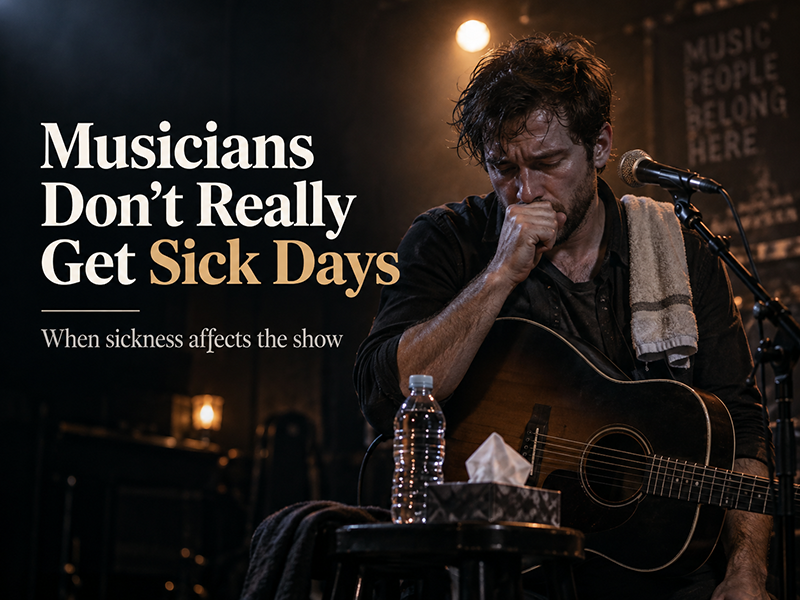
Musicians Don’t Really Get Sick Days
Sometimes professionalism means finding a way to get through the show.
Sometimes professionalism means knowing when you shouldn’t.
The difficult part is deciding where that line is.
If you’re a working musician, getting sick can be a lot more complicated than simply feeling ordinary for a few days.
For most people, a cold might mean going to work feeling a bit miserable, keeping some tissues nearby, drinking plenty of water and getting through the day.
When your job involves singing for three hours, things can be very different.
I’ve performed through plenty of minor colds and illnesses over the years. If I think I can manage it, I’ll usually give it a go. Plenty of water, chewing gum, taking things a bit easier and choosing the right songs can sometimes be enough to get through a gig.
But once coughing starts, that changes everything for me.
After enough coughing, my throat becomes sore and irritated, my voice gets croaky, and eventually there simply isn’t much voice left to work with.
And you can’t fake your way around that.
When "Just a Cold" Stops You Working
Only around three weeks ago, I had a relatively minor head cold.
I cancelled two gigs that weekend because I wanted to play it safe, recover properly and be ready for the following week.
Then I got sick again.
This time it hit harder and moved into my chest.
This past weekend I played three gigs, Thursday, Friday and Saturday nights.
By Saturday night, my voice was in serious trouble.
Before the gig, I had already been questioning whether I should cancel. I hate cancelling gigs, so I convinced myself that if I took things easy, avoided the higher songs and concentrated on material that sat lower in my range, I might be able to get through the weekend.
That plan didn't last very long.
After the first set, some of the locals who regularly come to my gigs could see that I was struggling.
One of them, Laura, enjoys singing and asked if I wanted her to jump up and do a few songs.
At that point, I wasn't going to argue.
I gave her the link to the repertoire on my website and she went through it, picked out songs she knew and made herself a list.
For most of the next two sets, Laura sang while I played.
It basically got me through the night.
At the end of the gig I thought I'd try to sing one final song myself.
That was a mistake.
I chose a Keith Urban song that I would normally sing without thinking twice about it.
The problem wasn't that I couldn't work out the notes or couldn't keep pitch.
The notes simply weren't there.
I knew exactly what I needed to sing. I'd sung it countless times before.
But my voice physically wasn't capable of producing what I was asking it to do.
I fumbled my way through the song, thanked Laura over the microphone for helping me survive the night, packed up and went home.
By Sunday morning, I could barely talk.
The Sunday gig in Orange had to be cancelled.
Cancelling Is Harder Than People Think
Most venues I've dealt with are very understanding when somebody is genuinely sick.
People get sick. It happens.
But I still hate cancelling.
You feel like you're letting the venue down.
You feel like you're letting yourself down.
There might be people planning to come specifically because you're playing.
And then there is the financial side.
As a sole trader, there is no sick leave.
If I don't perform, I don't get paid.
A cancelled weekend can potentially mean losing up to $2,000 in income.
That makes it very tempting to convince yourself that you'll somehow get through it.
Maybe you'll feel better once you start.
Maybe the adrenaline will kick in.
Maybe if you change a few songs around you'll survive the night.
Sometimes you do.
Sometimes you make things worse.
I've learned that lesson before. I've completely lost my voice in the past and been unable to sing properly for weeks.
So I should probably have known better this time too.
Singing Sick Isn't the Same as Going to Work Sick
This is something I don't think everyone understands.
Someone might hear that a musician cancelled because of a cold and think:
"It's only a cold."
And technically, they may be right.
But your ability to do your job depends on what your job actually is.
Try standing in front of a crowd when you're coughing up phlegm, your throat is sore, you can barely talk and your chest is congested.
Now sing for three hours.
And when I say sing, remember what singing actually involves physically.
You're controlling your breathing constantly.
You're taking quick inhalations between lines.
You're sustaining notes.
You're projecting.
You're controlling pitch while regulating air pressure.
If your throat and chest are full of congestion and you're trying desperately not to cough every time you take one of those quick breaths, even a song you've performed hundreds of times suddenly becomes hard work.
And once you've spent the day coughing, your voice may already be exhausted before you've sung the first note.
Trying to Work Around It
Over the years I've tried most of the obvious workarounds.
I've lowered the keys of songs.
I've removed the higher songs from the set.
I've played longer guitar solos.
I've stretched instrumental sections.
I've chosen songs that sit comfortably in the lower part of my range.
I've talked as little as possible between songs.
If I'm sick at a gig, I tend to keep to myself anyway.
Part of that is trying not to spread whatever I have to everyone around me.
The other reason is simply vocal preservation.
Every conversation is more work for a voice that I'm already asking to survive several hours of singing.
Outside the gigs, I keep things pretty simple.
Rest.
Plenty of water.
Steam.
And as little unnecessary talking as possible.
But there comes a point where changing keys, stretching guitar solos and drinking more water isn't going to solve the problem.
Sometimes your voice is simply gone.
Finding Someone Else Isn't Always Easy
When someone working a normal roster calls in sick, another employee might be able to take their shift.
Live entertainment doesn't always work like that.
Finding another musician at short notice can be difficult.
Some venues have systems or contacts they can use to find someone quickly.
Others simply cancel the entertainment for the night.
And sometimes a venue has booked a particular performer because that is who they wanted.
That puts another layer of pressure on the musician making the decision.
Do I cancel now and potentially leave the venue without entertainment?
Or do I turn up and hope I can somehow get through it?
There isn't always an obvious answer.
The Mental Battle
This is probably the part I find most frustrating.
Mentally, you're fine.
You know the songs.
You know the gig.
Your hands still work.
Your equipment still works.
You want to play.
But your body has taken away the one thing you absolutely need.
Your voice.
It can feel ridiculous because you're sitting at home thinking, "It's a cold."
Most people have gone to work with a cold plenty of times.
But when your voice is your job, a cold can effectively make you unable to work.
I also seem to pick illnesses up fairly easily, which makes the whole thing even more frustrating when you've only just recovered from the last one.
When Cancelling Is the Professional Decision
I've been doing this long enough now to know that pushing through isn't always the brave or professional option.
Sometimes it is the wrong decision.
You can struggle through one gig and potentially make it harder to perform the next several.
You might deliver a performance that you're unhappy with.
You might spend the whole night fighting your own voice instead of entertaining the room.
And you may simply be delaying your recovery.
These days, if I genuinely know I'm going to struggle, I'd rather cancel.
I still hate doing it.
I probably always will.
But most venues understand.
I'd rather disappoint someone for one night than turn one bad night into several weeks of problems.
This past weekend was probably a reminder of that.
I tried to push through.
I almost made it.
And thanks to Laura unexpectedly stepping in and singing for most of Saturday night, we still managed to finish the gig.
But by Sunday morning, there wasn't really a decision left to make.
There was no voice.
Knowing When to Stop
There isn't a perfect rule for musicians.
Sometimes you wake up feeling ordinary, go to the gig and end up feeling better once you start.
Other times you convince yourself you're fine and discover halfway through the first set that you've made a terrible decision.
That's part of working for yourself.
There is no manager standing there telling you to go home.
There is no paid sick day waiting for you.
There isn't always another musician ready to take your place.
You have to make the call yourself.
And sometimes that means accepting the lost income, apologising to the venue, staying home and getting better.
Because being professional doesn't always mean the show must go on.
Sometimes professionalism means finding a way to get through the show.
Sometimes professionalism means knowing when you shouldn't.
The difficult part is deciding where that line is.