The Gig Isn’t Over Until Your Gear Is Safely Inside
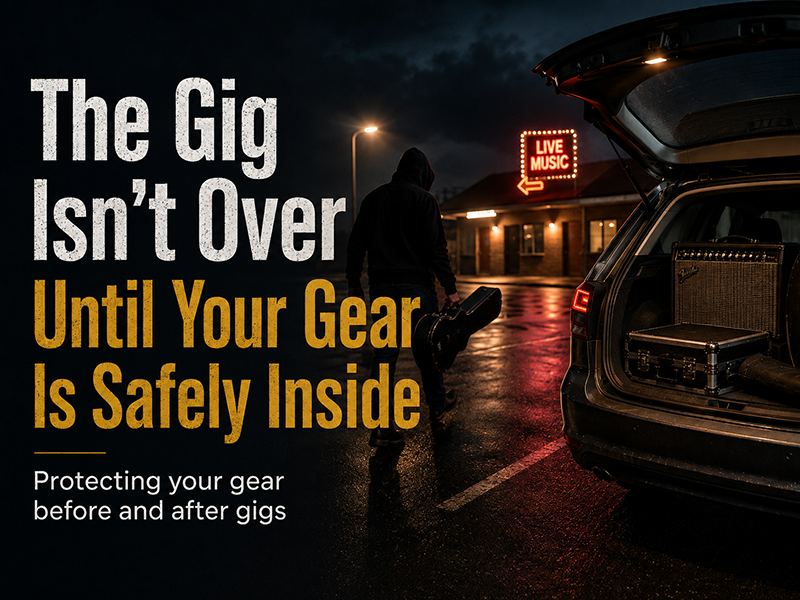
The Gig Isn’t Over Until Your Gear Is Safely Inside
Most musicians spend years building up their gear.
Guitars, amps, PA systems, microphones, pedals, mixers and cables can represent thousands, sometimes tens of thousands, of dollars. More importantly, a lot of that equipment is what allows us to earn an income.
Yet one of the biggest risks to that gear often happens when we're not even playing.
It happens while we're loading in, loading out, travelling, staying overnight or making a quick stop on the way home.
Over the years I've heard far too many stories from musicians who have had equipment stolen, and a few of them have stuck with me.
One musician friend travelled to Cowra for a gig and stayed overnight at a nearby motel. While he was asleep, thieves got into his vehicle and stole his gear.
It was never recovered.
Another guitarist in Canberra was loading out after a gig. He placed his amplifier near a rear exit while he went back to collect his guitar and effects so he could take everything to the car together.
By the time he returned, the amplifier was gone.
Again, never seen again.
Another musician in Orange left a guitar case near a doorway while loading equipment. CCTV later showed a bloke simply picking up the case and walking out with it.
And more recently, another musician friend had gear stolen from their vehicle overnight. Their entire PA system, microphones and other equipment disappeared.
The guitar was about the only thing left.
Those are just a few of the stories I've heard.
It Doesn't Take Long
One of the things these stories have in common is that none of the gear needed to be left unattended for very long.
An amplifier sitting near a door.
A guitar case waiting to be loaded.
Equipment inside a car overnight.
You don't necessarily need to leave thousands of dollars worth of gear sitting in a car outside a shopping centre for three hours to lose it.
Sometimes a thief only needs thirty seconds.
That is why, after hearing the first few stories years ago, I became pretty strict about how I handle my gear before and after gigs.
My Rule: Minimise the Opportunities
When I'm travelling to or from a gig, I try not to go anywhere except the venue.
If I can avoid stopping at shopping centres, malls or anywhere else where I would have to park the car and leave it out of sight, I do.
Obviously life doesn't always cooperate. You might need fuel, food or a toilet stop. But every unnecessary stop with a vehicle full of musical equipment is another opportunity for something to happen.
The same applies when I arrive at a venue.
Wherever possible, I make sure my gear fits onto one trolley load.
That isn't just about making load-in easier. It means I'm not leaving equipment sitting unattended on the footpath, near a doorway or in an unlocked vehicle while I make repeated trips.
If I can't fit everything onto one load, the expensive items go inside first.
The car gets locked.
Then I go straight back for the rest.
Once the gear is inside the venue, it goes to the stage rather than being left near an entrance or exit where someone can easily pick something up and disappear.
And when I get home after the gig, regardless of how tired I am, the gear comes out of the car and goes back into my music room.
No question.
It would be very easy after getting home at midnight, 1am or 2am to think, "I'll unload it tomorrow."
But that's exactly the sort of decision that could become very expensive.
Don't Create an Easy Theft
Some theft is impossible to predict or prevent.
If somebody is determined enough, they may still find a way.
But musicians can at least avoid making the job easy.
A guitar case beside an exit looks like a guitar case.
An amplifier sitting alone beside a loading door doesn't need much explanation.
A vehicle packed with speaker bags, mic stands and equipment cases is fairly obvious to anyone watching a musician load out.
And remember that venues are public places.
Just because someone is standing in the venue doesn't mean they are a staff member, musician or even a customer you've noticed during the night.
During load-out especially, doors are often open, musicians are distracted, venue staff are cleaning up and everyone assumes everyone else belongs there.
That's a perfect opportunity for someone to walk away with something.
A Few Habits That Can Reduce the Risk
There is no foolproof system, but there are some simple things musicians can do.
Keep equipment with you during loading.
Try to avoid leaving guitars, amps or equipment cases sitting beside exits while you go back for another load.
If you use a trolley, organise your rig so you can move as much as possible in one trip.
Take the valuable items first.
If multiple trips are unavoidable, prioritise guitars, pedalboards, laptops, wireless systems, microphones and other expensive or easily carried items.
Lock the vehicle between trips.
Don't leave gear in the car overnight.
Sometimes circumstances make this difficult, particularly when travelling for gigs, but a vehicle sitting outside a motel containing thousands of dollars worth of equipment is a risk.
If practical, take the most valuable and portable items into your room.
Be careful about unnecessary stops.
If your vehicle is full of equipment, think about where you're parking and whether the vehicle will be out of sight.
Sometimes skipping that quick shopping trip until after you've unloaded is the safer option.
Photograph your equipment.
Take clear photographs of your guitars, amps, PA equipment, pedals and other valuable items.
Include distinguishing marks, modifications, scratches or anything else that could help identify them.
Keep your serial numbers.
Store serial numbers somewhere separate from the gear itself.
If something disappears, being able to provide police, insurers, pawn shops and other musicians with an exact serial number gives you a much better way of identifying it than saying, "It's a black Fender."
Consider GPS trackers.
I haven't personally done this, but trackers such as AirTags or dedicated GPS devices could be worth considering for expensive guitars, PA systems or equipment cases.
A tracker isn't a substitute for preventing the theft in the first place, but it may provide another option if something does disappear.
Insure your gear.
If you're carrying thousands of dollars worth of equipment to gigs every week, insurance is worth investigating.
Just make sure you understand exactly what your policy covers, particularly equipment stored in vehicles or left unattended.
Those details matter.
Think About What Your Gear Is Actually Worth
It's easy to underestimate the value sitting in the back of a musician's vehicle.
Add up a couple of guitars, amplifier, PA system, mixer, microphones, wireless systems, pedalboard, stands, cables, cases and accessories.
Suddenly you're not carrying a few bits of music equipment.
You're carrying a small car's worth of gear.
And for working musicians, replacing it isn't simply a financial inconvenience.
If your PA disappears on Friday night and you have another gig Saturday, you still have a job to do.
If your main guitar is stolen, money doesn't instantly replace years of familiarity with that particular instrument.
Some pieces may not even be easily replaceable.
The Gig Isn't Over When the Last Song Finishes
We spend plenty of time thinking about looking after equipment onstage.
Cases, stands, surge protection, backup cables, spare batteries and everything else.
But some of the most vulnerable moments happen after we've packed it away.
I've been fortunate. I haven't had gear stolen and I haven't had a close call.
I'd like to keep it that way.
Hearing what has happened to other musicians was enough to change the way I approach loading, unloading and travelling with equipment.
The inconvenience of unloading the car when you're exhausted at 2am is nothing compared with walking outside the next morning and discovering your PA, guitars or amplifiers are gone.
Pack carefully.
Load carefully.
Lock the car.
Keep the valuable stuff close.
And when you get home, bring it inside.
Because the gig isn't over until your gear is safely inside.
My After-Gig Gear Checklist
Before I consider the night finished, I make sure:
Nothing is left near an exit or loading door
All guitars, pedals, microphones and other high-value gear are accounted for
The car stays locked between loads
I avoid leaving gear unattended while making multiple trips
Everything is loaded securely and out of obvious view where possible
I go straight home rather than making unnecessary stops
When I get home, all gear comes out of the car
Guitars, PA, microphones and other equipment go back into the music room
Nothing stays in the vehicle overnight
It only adds a little extra effort at the end of a gig, but that effort is a lot cheaper than replacing a stolen guitar, amplifier or PA system.